
Heating Btu Calculator
Estimate how much heating capacity a room or home needs. Enter the floor area, ceiling height, insulation level and your climate, and the calculator gives BTUs per hour, the equivalent in kilowatts and a suggested heater or furnace size.
- Free to use
- No sign-up
- Runs in your browser

Calculate heating BTUs
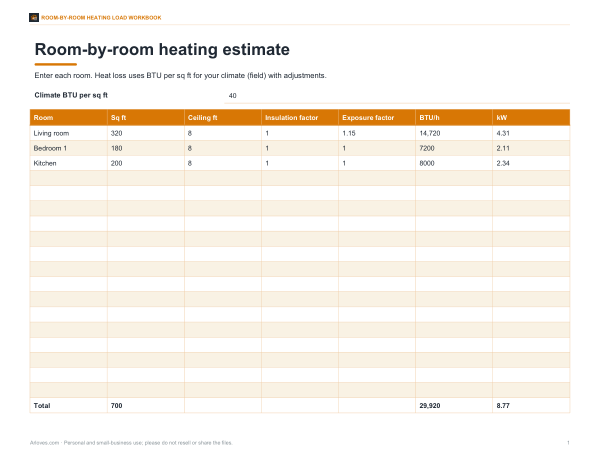
Room-by-Room Heating Load Workbook
Estimate heat loss room by room with wall, window and air-leakage inputs, total the house load and compare equipment options.
- Room heat loss workbook (XLSX, PDF)
- Units & rules of thumb card (PDF, XLSX)
Formats: XLSX, PDF. Instant download after payment (link valid 72 hours, up to 5 downloads). AI-assisted: the templates were drafted with AI help and reviewed and laid out before publishing.
$5.00 USD, one-time
- Instant download
- 7-day refund
- Secure checkout by Stripe
7-day money-back guarantee. Full refund within 7 days of purchase, even after you download.
Full refund within 7 days — see the refund policy and license.
Free printables
Single sheets you can print right now, no sign-up. The full pack adds every sheet in one download plus the editable files.
How heating BTUs are estimated
A BTU (British thermal unit) is the heat needed to raise one pound of water by 1 °F. Heating equipment is rated in BTUs per hour (BTU/h): how much heat it can deliver continuously. To size a heater, you estimate how fast your space loses heat on a cold day, which depends mainly on its size, how well it is insulated, how many windows and exterior walls it has, and how cold your climate gets. This calculator uses a common rule of thumb — BTUs per square foot by climate — then adjusts for ceiling height, insulation and exposure.
- Base load = floor area × BTU/h per sq ft for your climate (about 25 in warm zones up to 55+ in very cold zones).
- Adjust for ceiling height: × (ceiling height ÷ 8 ft).
- Adjust for insulation and windows: × 0.8 for excellent, × 1.3 for poor.
- Adjust for exposure: × 0.9 for interior rooms up to × 1.15 for corner rooms with many windows.
- Divide by efficiency to get the input rating for combustion appliances.
Worked example
A 400 sq ft room with 8-foot ceilings in a mixed climate (about 40 BTU/h per sq ft), average insulation and typical exposure needs about 16,000 BTU/h of heat — roughly 4.7 kW. A single 1,500-watt space heater delivers about 5,100 BTU/h, so it would only take the chill off. A 240-volt wall heater of around 4–5 kW, a ductless mini-split, or a zone from a central system would be more appropriate. A gas furnace with 95% AFUE would need about 16,800 BTU/h of input to deliver that output.
Typical heating needs by climate
| Climate | Approx. BTU/h per sq ft | 1,000 sq ft needs | 2,000 sq ft needs |
|---|---|---|---|
| Warm (zones 1–2) | 20–30 | 20,000–30,000 | 40,000–60,000 |
| Mild (zone 3) | 30–35 | 30,000–35,000 | 60,000–70,000 |
| Mixed (zone 4) | 35–45 | 35,000–45,000 | 70,000–90,000 |
| Cold (zone 5) | 45–50 | 45,000–50,000 | 90,000–100,000 |
| Very cold (zones 6–7) | 50–60 | 50,000–60,000 | 100,000–120,000 |
Why rules of thumb are only a starting point
Real heat loss depends on insulation R-values in walls, attic and floor, window area and type, air leakage, the local design temperature (a cold-weather benchmark for your area), and even the direction the house faces. Oversizing is common and costly: an oversized furnace short-cycles, heats unevenly and wears out faster; an oversized heat pump may control humidity poorly. For whole-house systems, heating contractors in the US use ACCA Manual J, a detailed room-by-room load calculation. Use this calculator to sanity-check a quote or size a single room heater.
Converting between units
| From | To | Multiply by |
|---|---|---|
| Watts | BTU/h | 3.412 |
| kW | BTU/h | 3,412 |
| BTU/h | kW | 0.000293 |
| Tons (heat pumps/AC) | BTU/h | 12,000 |
| Therms per hour | BTU/h | 100,000 |
A 1,500-watt plug-in heater produces about 5,118 BTU/h. A 3-ton heat pump is nominally 36,000 BTU/h, though heat pump output falls as outdoor temperatures drop — check the manufacturer's capacity at your design temperature.
Choosing a heater type
- Plug-in space heaters — up to about 1,500 W (5,100 BTU/h) on a standard US circuit; best for supplemental heat in small spaces.
- Electric wall and baseboard heaters — hard-wired, often 240 V, good for individual rooms and additions.
- Ductless mini-split heat pumps — efficient heating and cooling for rooms or zones; check low-temperature ratings in cold climates.
- Furnaces — gas, propane or oil; rated by input BTU/h and AFUE efficiency.
- Central heat pumps — sized in tons; cold-climate models maintain more output at low temperatures.
- Garage and workshop heaters — vented gas or electric unit heaters; follow ventilation requirements.
Reducing the heat you need
- Seal air leaks around windows, doors, outlets and the attic hatch.
- Add attic insulation to the level recommended for your climate.
- Use heavy curtains at night and open them on sunny winter days.
- Close off unused rooms if your system allows.
- Install a programmable or smart thermostat and lower the temperature at night.
Safety with space heaters
Portable heaters are a common cause of home fires. Keep them at least three feet from anything that can burn, plug them directly into a wall outlet rather than an extension cord or power strip, choose models with tip-over and overheat protection and a recognised safety certification, and turn them off when you leave the room or go to sleep. Fuel-burning heaters indoors need proper venting and a working carbon monoxide alarm nearby.
Frequently asked questions
How many BTUs do I need to heat 1,000 square feet?
Roughly 30,000–60,000 BTU/h depending on climate and insulation.
How many BTUs is a 1,500 W heater?
About 5,100 BTU/h.
What size furnace do I need?
Use this as an estimate, but have a contractor perform a Manual J calculation for your home before buying.
Is it better to oversize a heater?
No. Oversized equipment short-cycles, wastes energy and can be less comfortable.
What is AFUE?
Annual fuel utilisation efficiency: the percentage of fuel energy a furnace turns into heat over a season.
How do tons convert to BTUs?
One ton of heating or cooling capacity is 12,000 BTU/h.